



Evaporative Condenser: How It Works, Selection Tips, and Air-Cooled vs Water-Cooled
A freezer warehouse holding -30°C rooms loses money quickly once summer heat drives condensing pressure up: in a typical industrial system, every extra degree of condensing temperature adds roughly 2-3% to compressor energy use, so the heat rejection equipment you pick today shapes your power bill for the next 15 to 20 years.
The short version: an evaporative condenser condenses refrigerant inside a water-sprayed coil while a fan drives air across it, so it reaches a lower condensing temperature than an air-cooled condenser and needs far less plot area than a water-cooled condenser paired with a cooling tower. The cost of that performance is a recirculating water system that needs treatment, winterization, and routine cleaning. These are manageable tasks, but you must plan for them from day one.
This guide covers how the equipment works, where it beats the alternatives, what to verify before signing a purchase order, and what upkeep actually involves. It is written from a manufacturer's standpoint: Zhejiang Lanxi Refrigeration Equipment builds evaporative condensers, air-cooled condensers, and complete compressor packages for food processing, cold chain logistics, pharmaceutical, and frozen storage projects.
How an Evaporative Condenser Works
Inside the casing sit four core components: a coil bundle carrying the refrigerant, a spray water system with pump and nozzles, an axial fan, and a water basin with drift eliminators. Hot discharge gas from the compressors enters the coil. The pump lifts water from the basin and sprays it over the outside of the tubes while the fan moves air across the wet surface. As a small share of that water evaporates it absorbs heat, and the refrigerant vapor inside the coil gives up its latent heat and condenses, draining into the receiver. Water that does not evaporate falls back into the basin for recirculation, a bleed line carries away concentrated minerals, and drift eliminators capture droplets before air leaves the unit.
The operating sequence runs like this:
- Compressors discharge hot refrigerant vapor into the condenser coil.
- The spray pump wets the full coil surface from the basin below.
- The fan draws ambient air across the wetted coil.
- A portion of the spray water evaporates, removing heat through the tube wall.
- Refrigerant condenses and flows to the receiver, then to the expansion device.
- A float or conductivity probe meters make-up water and bleed to keep water chemistry stable.
The single most important selection number is the approach temperature: the difference between design condensing temperature and your site's design wet-bulb. Industrial selections commonly sit 8-14°C above wet-bulb. A smaller approach means a larger coil and more fan power, but lower compressor energy every operating hour. That trade-off is the heart of sizing.
Evaporative Condenser vs Air-Cooled vs Water-Cooled
An air-cooled condenser rejects heat sensibly, with air alone crossing a finned coil, so condensing temperature tracks the dry-bulb, typically 10-18°C above it. A water-cooled condenser with a cooling tower achieves wet-bulb-based performance but splits the job across condenser, pump set, and tower joined by condenser water piping. An evaporative condenser merges the condenser and the tower into one shell and removes the intermediate heat exchanger and its pump penalty entirely.
| Aspect | Evaporative condenser | Air-cooled condenser | Water-cooled condenser cooling tower |
|---|---|---|---|
| Heat rejection principle | Latent heat: spray water evaporates off the coil | Sensible heat: air across a finned surface | Sensible heat to a water loop, then evaporation in a separate tower |
| Condensing temp on a 35°C dry-bulb / 24°C wet-bulb day | About 33-38°C | About 48-53°C | About 38-44°C |
| Water consumption | Evaporation and bleed only; no condenser water piping | None | Tower evaporation, drift, and bleed, plus pump and pipe losses |
| Plot area | Single unit; smallest footprint per kW rejected | Large coil face; often several units | Condenser, pump set, and tower occupy separate spaces |
| Typical maintenance | Water treatment, nozzles, basin, winterization | Fin and fan cleaning | Two systems: condenser water circuit and tower fill |
| Best fit | Industrial ammonia, CO2, and HFC systems on tight sites | Smaller loads; sites without reliable water | Large chiller plants that already run cooling towers |
Condensing temperature at design conditions
These are indicative figures for one climate point; your actual selection depends on local wet-bulb, refrigerant, and the approach you buy. But the roughly 10-15°C gap at the top is the whole story: that gap is what your compressors stop paying for at peak season.
If your site has no dependable water supply, thin maintenance coverage, or only a moderate load, an air-cooled condenser removes water treatment from the equation entirely and stays competitive in dry or mild climates. For those projects we supply the FNV series alongside the evaporative range:
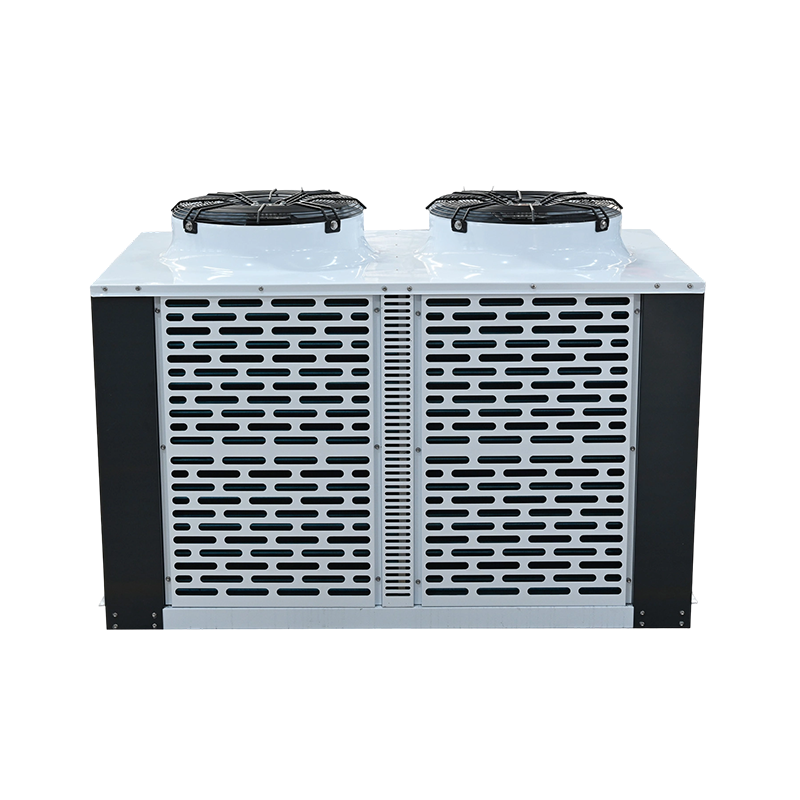 FNV Series Air-Cooled Condenser An air-cooled condenser for refrigeration and industrial systems, suited to sites without dependable water supply. It keeps heat rejection competitive in dry or mild climates, helping ammonia plants lower condensing pressure and cut compressor energy use. View Product →
 Where an Evaporative Condenser Earns Its Keep
Low-temperature cold chain and food processing
Blast freezers and -25 to -35°C storage rooms are the classic territory. These plants overwhelmingly run ammonia (R717), a refrigerant that rewards every degree of lower condensing pressure, and operators float head pressure down toward the condenser's capability as ambient conditions ease. Combine the 2-3% compressor saving per degree with long annual run hours and the choice of rejection option becomes a five-figure energy item for a mid-size distribution center. The shift toward natural refrigerants reinforces the pattern, as we noted when covering how natural refrigerant adoption keeps growing across cold chains.
For plants in this category, our evaporative condenser is selected against your design wet-bulb and total heat of rejection, then matched to the compressor package rather than sold as a stand-alone box:
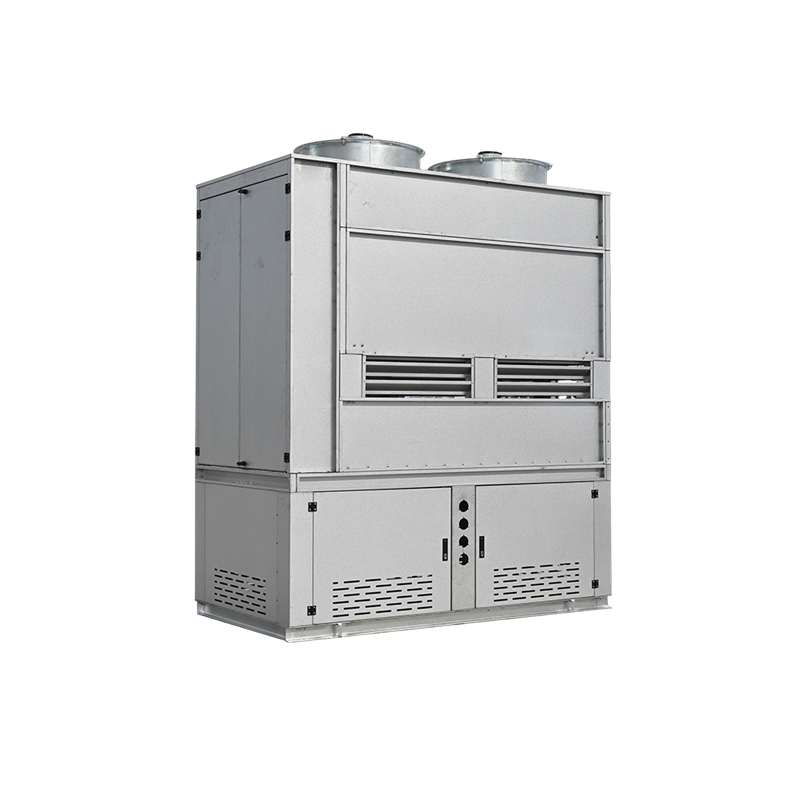 Evaporative Condenser for Industrial Refrigeration Selected against design wet-bulb and total heat of rejection, this evaporative condenser combines air and water cooling for lower condensing temperatures. In ammonia plants it reduces compressor power per degree of floating head pressure over long annual run hours. View Product →
 Pairing with liquid recirculation and compressor packages
In ammonia plants the condenser rarely works alone. A barrel pump unit recirculates low-pressure liquid refrigerant to the evaporators at several times the evaporation rate, which improves coil wetting in freezers and simplifies oil return. The evaporative condenser sits on the high-pressure side of the same circuit, so the two products are usually specified together, along with screw or piston compressor packages. Bitzer, Fusheng, Hanbell, Refcomp, and RFC units in our program cover high, medium, and low temperature duties:
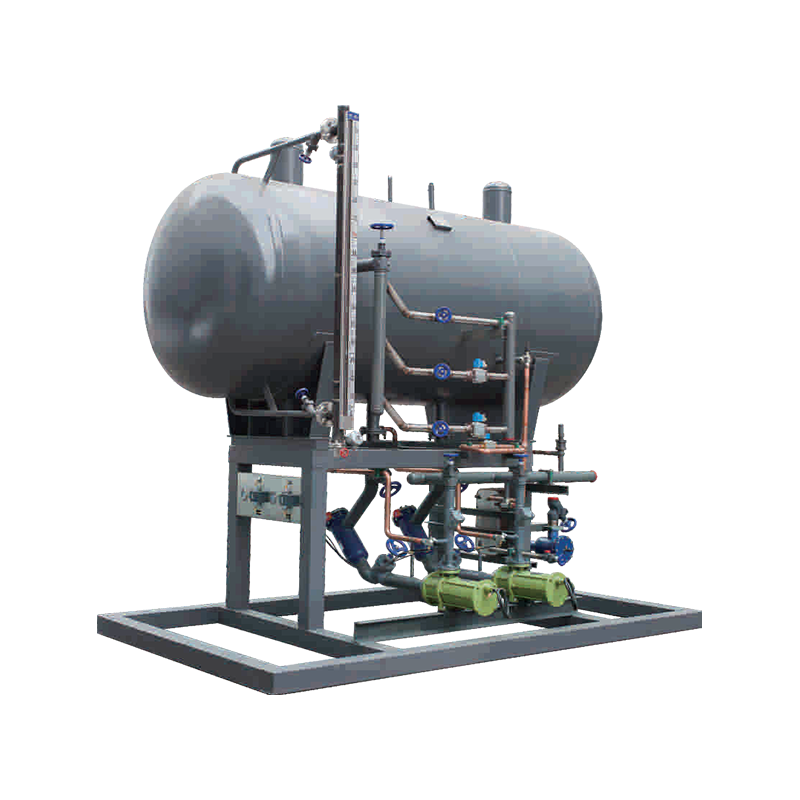 Barrel-Pump Unit for Ammonia Refrigeration A low-pressure recirculation unit that feeds liquid refrigerant to evaporators at several times the evaporation rate, improving coil wetting in freezers and simplifying oil return. Usually specified alongside the evaporative condenser on the same ammonia circuit. View Product →
 What to Check Before You Buy
Most disappointments with evaporative condensers trace back to selection and site preparation, not to the concept. Work through these points in order:
- Size on total heat of rejection: evaporator load plus compressor power input at design conditions, not nameplate capacity. Underestimating it is the most common cause of high summer head pressure.
- Compare quotes at identical wet-bulb and approach. A unit quoted at a 14°C approach looks smaller and cheaper than one at 10°C, then costs you more energy every year. Ask every bidder to state both numbers.
- Bring water quality data. Hardness and dissolved solids determine cycles of concentration, bleed rate, and treatment. Skipping this step is how coils scale and nozzles clog.
- Confirm winterization. In freezing climates, ask for basin heaters or drain-down arrangements, and check whether a split coil is offered for partial free cooling in cold months.
- Check fan control. Variable frequency drives with floating head pressure control extract the most savings from low ambient conditions; two-speed fans are the budget fallback.
- Agree on logistics and spares. Large units ship in splits and assemble on site, so confirm lifting points, piping scope, and which pump and fan spares arrive with the order.
Running and Maintaining the Unit
Once installed, the equipment asks for steady, simple attention rather than heroic interventions:
- Check the spray pattern weekly; dry patches on the coil from a single blocked nozzle raise local condensing temperature and waste capacity.
- Clean nozzles and inspect drift eliminators monthly, more often on dusty sites.
- Run bleed on conductivity control and verify inhibitor and biocide dosing on a fixed schedule.
- Winterize before the first freeze: confirm basin heater operation, drain down if the unit idles, and reverse fans occasionally to shed ice.
- Inspect the coil annually; even a thin scale layer insulates the refrigerant from the spray water and lifts head pressure, so chemical cleaning pays for itself quickly once deposits appear.
Treat water care as an operating cost from day one and the unit will hold its published approach for years. Treat it as an afterthought and capacity quietly erodes while the compressors pick up the bill.
The Bottom Line
Choose an evaporative condenser when the heat rejection load is substantial, your site's design wet-bulb is moderate, plot area is tight, and the team can commit to water treatment and winter checks. Choose air-cooled when water is unavailable or the load is small enough that the condensing temperature penalty does not matter. Choose a water-cooled condenser with a tower when the plant already operates tower infrastructure. For most industrial ammonia and CO2 projects, including cold storage, food processing, and pharmaceutical low-temperature duty, the evaporative route remains the strongest default.
Zhejiang Lanxi Refrigeration Equipment supplies the condenser as part of a complete system: evaporative and air-cooled condensers, air coolers, barrel pump units, and screw and piston packages built on Bitzer, Fusheng, Hanbell, Refcomp, and RFC compressors, with equipment selection, project planning, and system design available from one source. Share your design wet-bulb, refrigerant, and load profile, and our engineers will return a sized selection with the approach temperature stated explicitly, so you can compare every offer line by line.
-
A dual discharge unit cooler — also known as a double side discharge air cooler, dual-flow evapor...
READ MORE -
In a busy cold storage room or food processing line, a poorly selected industrial air cooler c...
READ MORE -
Een vatpompeenheid is de meest praktische manier om viskeuze of gevaarlijke vloeistoffen uit v...
READ MORE -
De fabrikant met de laagste prijsopgave is zelden degene die de laagste totale kosten leve...
READ MORE -
Een koelopslagmanager in een voedselfabriek belde ons ooit over een unit die in juli een vries...
READ MORE -
Wanneer een keukenmachine een nieuwe -18°C vriezer plant, gaat de eerste beslissing over de ui...
READ MORE

- E-mail: [email protected]
- Telefoon: +86-15258555916
- Adres: 301 Punan Avenue, Pukou Street, Shengzhou City, Shaoxing City, provincie Zhejiang.China
Auteursrecht © Zhejiang Lanxi Refrigeration Equipment Co., Ltd. Alle rechten voorbehouden.
浙ICP备2022034605号-1
 Fabrikant van op maat gemaakte koelapparatuur
